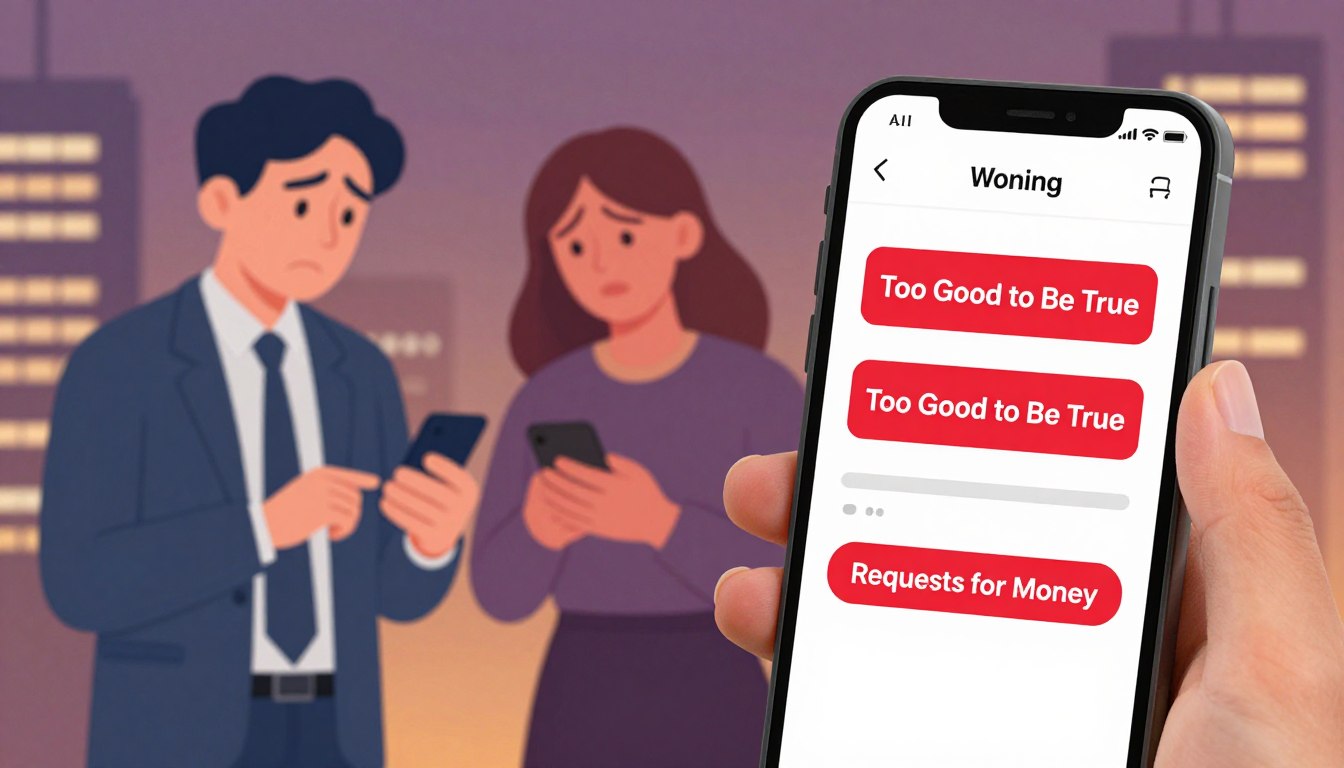
Finding a real connection online can be tough. Today’s digital world is full of sophisticated scammers targeting folks looking for love.
Romance scams are a growing problem on many popular platforms. Thousands of people worldwide get hurt each year, both emotionally and financially.
This guide is here to help. We’ll show you how to navigate online dating safely and protect yourself from harm.
Con artists have gotten very clever. They create elaborate stories to gain trust. If a match looks like a supermodel and quickly asks you to invest in crypto, that’s a major red flag.
Whether you’re new to these apps or a seasoned user, our advice is practical and actionable. We want you to enjoy meeting new people without fear.
You’ll learn to identify warning signs, understand how to report fraud, and see real examples of how these schemes work. Knowledge is your best defense.
By spotting romance scams early, you safeguard your money, personal details, and heart. You can still find meaningful romance with the right tools.
Key Takeaways
- Romance scams are increasingly common on digital dating platforms.
- Scammers use sophisticated tactics, including fake profiles and fast financial requests.
- Immediate requests for money or cryptocurrency investments are major red flags.
- Protecting your personal and financial information is crucial for safe online dating.
- Learning to identify warning signs can prevent both emotional and financial harm.
- Reporting suspicious activity helps protect the wider community of users.
- This guide provides tailored advice for navigating specific app environments safely.
Overview of the Rising Threat in Chinese Dating Apps
A recent surge in matchmaking-related prosecutions reveals a troubling trend within a booming industry. China’s Supreme People’s Procuratorate reports over 1,500 people were charged with such crimes last year alone.
The matchmaking sector’s value has more than tripled since 2014, reaching 9.38 billion yuan. This explosive growth creates lucrative opportunities for legitimate services and fraudulent operators alike.
Despite a record-low marriage rate, demand for connection is soaring. Over 46,500 new matchmaking companies were established in 2024.
A significant regulatory gap enables this problem. Agencies face no prior registration review, and matchmakers need no mandatory qualifications. This lack of oversight allows bad actors to operate freely.
Popular platforms like Momo, Tantan, Baihe, and Zhenai attract millions seeking genuine romance. Unfortunately, they also attract sophisticated criminals looking to exploit vulnerable people.
The COVID-19 pandemic accelerated a shift from in-person tourist cons to online fraud. Scammers adapted to travel restrictions and our increased digital footprints.
These schemes do more than steal money. They erode trust in legitimate services, making it harder for honest individuals to find meaningful connections. Victims come from all walks of life, including newcomers and long-term residents.
How Scams Operate on Chinese Dating Platforms
Fraudulent operations on social and dating platforms follow a predictable, yet highly effective, pattern. This romance scam blueprint is designed to manipulate feelings and bypass logical defenses.
It all starts with a fabricated identity. Scammers create profiles using stolen photos and invented life details. They craft an image of an attractive, successful individual to spark initial interest.
The next phase is all about building trust. They invest significant time, messaging or calling multiple times daily. This intense communication fosters a false relationship and deep emotional connection.
To explain why they can’t meet in person, they use elaborate stories. Common excuses include working on an oil rig or being in the military. They often profess love very quickly to strengthen the bond.
Finally, a fabricated crisis emerges. It could be a medical emergency or a can’t-miss investment. This is when these scammers ask for money. The entire process is a rehearsed script run by organized groups.
Recognizing Red Flags and Warning Signs
Your gut feeling is often the first alert when a profile seems too good to be true. Learning to spot the subtle signs can protect your heart and your wallet.
Trusting your intuition is a powerful first step. Many romance scams succeed because the warning signs are ignored.
Spotting Suspicious Profiles and Behavior
Take a close look at the profile photos. Are they overly professional, like modeling shots or stock images? A picture that seems too perfect is a clue.
Remember, if someone looks like a supermodel and immediately asks you to invest in crypto, it is a scam.
Always do a reverse image search. This often shows the same photos on other sites under different names.
Be wary of specific meeting spots. In Shanghai, suggestions for People’s Square or East Nanjing Road Station are red flags 99% of the time.
Watch for a scammer who quickly wants to move your chat off the app. They also might declare love very fast.
Questions That Signal a Scam
Pay attention to the questions asked early on. A common one is, “How long have you been in Shanghai?”
Newcomers are often targeted because they know less about local tricks. Be cautious if they avoid your questions about their life details.
Another major warning sign is refusing a video call. Excuses every time you suggest one mean the person isn’t real.
Inconsistencies in their story over time are a clear signal. Your connection should feel honest and stable.
| Red Flag | What to Look For | Action to Take |
|---|---|---|
| Suspicious Photos | Overly perfect, model-like, or stock images. | Perform a reverse image search. |
| Rushed Emotional Connection | Professions of love within days. | Slow down and question the pace. |
| Evasion on Video Calls | Constant excuses to avoid live video. | Insist on verification or stop chatting. |
| Specific Meeting Locations | Insistence on known scam hotspots like People’s Square. | Suggest a public place you choose. |
| Early Financial Talk | Quick mentions of crypto or investment “opportunities”. | End communication immediately. |
The Influence of Cryptocurrency in Scams
The anonymous nature of digital currency makes it a perfect vehicle for scammers seeking untraceable payments. Cryptocurrency transactions are nearly impossible to reverse once completed. This makes them ideal for fraudulent schemes.
Crypto Investment Lures
Fraudsters often pose as successful crypto investors. They offer to teach you about cryptocurrency investment or share “insider” opportunities. These promises of unrealistic returns are always fake.
A critical warning sign is immediate pressure. If someone who looks like a supermodel quickly asks you to invest in crypto, it is absolutely a scam. No legitimate romantic interest would do this.
They build elaborate narratives with fake trading platforms and profit screenshots. This makes their crypto schemes appear legitimate and profitable.

Untraceable Payment Methods
Beyond crypto, scammers request other hard-to-trace payments. They want your money in ways that are difficult to recover.
Common methods include wire transfers through services like Western Union. Gift cards from Amazon or iTunes are also popular. Money transfer apps are another favorite tool.
Once you send funds via these channels, the money is essentially gone forever. There is virtually no recourse for recovery.
| Payment Method | Why Scammers Use It | Risk Level |
|---|---|---|
| Cryptocurrency | Transactions are anonymous and irreversible. | Extremely High |
| Wire Transfers | Funds are picked up quickly and internationally. | Very High |
| Gift Cards | Codes can be redeemed instantly and untraceably. | High |
| Money Transfer Apps | Payments are fast and often lack strong fraud protection. | High |
Remember, a real partner would never pressure you into financial decisions. Protecting your money is more important than any online romance.
Best Safety Practices for Online Dating on Chinese Apps
A simple rule can prevent the most common in-person fraud: you choose the spot. Taking control of the first meeting is your best defense.
This puts you in charge of the environment from the start. Legitimate matches will respect your caution.
Choosing Safe Meeting Spots
Always suggest the location yourself. Never agree to a cafe or tea house your contact insists on.
Scammers often have deals with specific places to overcharge victims. This is the classic “tea scam” setup.
Stick to reputable areas in Shanghai like Jing’an or Xuhui. Streets such as Wuding Lu or Yongjia Lu are excellent choices.
- Wuding Lu
- Fumin Lu
- Wulumuqi Lu
- Yongjia Lu
Chain establishments are safest. Wagas, Peet’s Coffee, and Bluefrog have standard, transparent prices nationwide.
This makes price-switching fraud impossible. You can relax and focus on the person.
Verifying Menus and Price Lists
Be vigilant even at your chosen spot. A common trick involves showing two different menus.
You see reasonable prices when you order. The bill comes from a menu with hugely inflated costs.
Always check the menu before ordering anything. If something feels off, verify the price list.
It’s smart to take a quick photo of it. This creates a record and discourages fraud.
Any establishment reluctant to show clear pricing is a major red flag. Be ready to walk away.
Share your plans with friends. Tell them where you’re going and when you’ll be back.
Also, take your time getting to know someone on the platforms. Rushing to meet is a tactic scammers use.
Genuine connections develop slowly. Protecting your life and wallet is the priority in any dating situation.
Social Media Tactics and Fake Profiles in Dating Scams
A convincing online persona is a scammer’s most powerful tool, and they build them with painstaking detail. These fraudsters create elaborate fake lives on platforms like Instagram or Facebook.
Their social media profiles show luxury, travel, and professional success. They even populate them with fake friends to support the illusion. This fabricated history aims to build trust for a romance scheme.
Scammers often push to move your chat to WhatsApp or Telegram. This removes the safety features of the original app. It also makes reporting their account much harder.
Verification is your best defense against a fake profile. Always conduct these two simple checks.
- Do a reverse image search on their photos. Stolen images often appear under different names online.
- Search their claimed job plus the word “scammer”. Other people may have already reported the same story.
Be very wary if they avoid a live video call. Some use pre-recorded clips instead of real-time conversation. A profile that seems too perfect, with no ordinary moments, is often a fake.
Chinese Dating Scams: Identifying the Tactics
From fake entrepreneurs to organized gangs, the methods used to defraud people seeking connection are both diverse and sophisticated. Understanding these specific romance scams is key to self-protection.
One common tactic involves a fraudster posing as a wealthy businessperson. They build a story over months before suggesting fake investment deals. In a similar long con, a woman surnamed Xu hid her family to develop a romantic bond, then invented emergencies to steal millions.
These are often organized operations. A 32-member gang used fake profiles on multiple platforms to pose as rich individuals. Other scammers, with surnames like Wang and Zhang, ran matchmaker fraud and “shill” schemes recruiting women from bars.
The core of these romance scams is emotional manipulation. They invest time to build a fake relationship and profess love. This trust makes the eventual crisis story—a medical or investment emergency—feel real and urgent.
| Tactic Name | Key Method | Reported Financial Impact |
|---|---|---|
| Wealthy Entrepreneur | Fake identity luring into fake investments | Varies per victim |
| The Long Con | Months-long fake romance, then fabricated crises | 3 million yuan (one case) |
| Organized Crime Gang | Multiple fake profiles on platforms for fake investments | Over 16 million yuan |
| Matchmaker Fraud | Introducing married women as single partners | Nearly 900,000 yuan |
| Shill Operation | Recruited women posing as romantic interests | Over 2.5 million yuan |
Steps to Reporting and Protecting Yourself
Taking immediate action is your strongest defense once you suspect you’ve been targeted by an online con. Knowing who to contact and what to say can stop further loss.
When to Call the Police
If you are in Shanghai, dial 110 for emergency help. Real police officers there speak English, so language is no barrier.
One English teacher faced a 15,000 RMB restaurant bill late at night. He made that call at 1 a.m. The police told him to go home without paying a dime.
Never feel ashamed to report this fraud. Con artists count on embarrassment to silence victims. Overcoming that feeling is a crucial step.

Contacting App Support and Financial Institutions
If you send money via wire transfer, gift card, or credit card, contact your bank right away. Provide all transaction details and request a reversal.
For cryptocurrency payments, alert the exchange or wallet service. While recovery is hard, it creates a paper trail.
Also, notify the social platforms where you met the person. Share screenshots and profile info to get their account removed.
In the United States, report the incident to the FTC at ReportFraud.ftc.gov. They track patterns and offer guidance.
Speed is critical. The sooner you act after you send money, the better your chance of freezing the transaction and protecting your account.
Real-Life Case Studies and Lessons Learned
Real stories from those who were targeted provide the clearest warnings about online deception. Examining these cases shows how criminals adapt and what victims can do to recover.
Case Study: The Tea Scam in Shanghai
A classic con involved friendly individuals approaching foreigners. They offered language practice and led people to a specific tea house.
The bill would suddenly show outrageous charges. This scripted fraud moved online when tourism stopped.
One young teacher met a person on a popular app. He went to her chosen cafe and ordered a drink.
Thugs then blocked the exit with a 15,000 RMB bill. The victim hid in a bathroom, his voice shaking with fear.
He was embarrassed and worried about his job. He even thought about borrowing the money.
Not knowing the emergency number, he called 110 as advised. Police told him to leave without paying.
He felt paranoid for days afterward. The experience left a lasting mark on his trust.
Stories of Victims and Recovery
Other fraud cases involve fabricated crises. A scammer might invent a family emergency needing urgent funds.
They pressure victims via phone or message, preying on compassion. The request for money feels like a test of the romance.
Always verify details before meeting anyone. Trust your instincts if something feels wrong.
Never go to a location your match insists on. Check menus and prices immediately when you sit down.
If presented with an unreasonable bill, refuse to pay. Most importantly, do not hesitate to call the police.
Authorities are there to help victims, not shame them. Sharing these lessons protects the wider community.
Conclusion
Genuine connections are still possible, even amidst widespread deception. While apps offer real opportunities for love, staying vigilant is key.
Remember the cardinal rule: if profile photos resemble a supermodel and requests for crypto investment come quickly, it is a scam. This fraud causes both financial and emotional trauma.
Protect yourself. Verify details, use reverse image searches, and insist on a video call. A real relationship builds with patience and trust, not pressure.
Choose meeting spots you know. Share plans with friends. If threatened, call the police immediately.
Do not feel ashamed if targeted. Reporting helps protect other people. By staying informed, you can enjoy online dating safely and find meaningful romance.
Share this guide to help create safer connections for everyone.

