
For years, the golden rule for online safety was simple: always video call to verify someone is real. I’m here to tell you that rule is now dangerously outdated.
Our digital world has undergone a radical shift. What we once considered foolproof verification can now be faked with shocking realism.
The rise of synthetic media and artificial intelligence has created a new landscape. A system built on trust is being undermined by technology that can generate convincing videos and images in real time.
Consider this: the digital companion market generates over $10 billion globally. Nearly one in three men under 30 in the U.S. has interacted with a simulated romantic partner.
This isn’t just about apps or entertainment. As researcher Laura Bates notes, this technology is “reinventing misogyny,” creating real dangers for women through fabricated content.
The way we connect and establish intimacy has changed more in the past 20 years than in the previous 2,000. People everywhere need new tools for this new reality.
Key Takeaways
- The old advice to “video call for verification” is no longer a reliable security measure.
- Advanced technology can now create real-time, convincing fake video calls and interactions.
- The market for digital companions and synthetic media is massive and growing rapidly.
- These technologies pose significant new risks, particularly regarding online safety and trust.
- Young adults are increasingly encountering and interacting with simulated personas.
- The digital landscape for relationships and identity has transformed faster than ever before.
- New methods and heightened awareness are required to navigate online connections safely.
Rethinking Traditional Verification: The Old Advice Under Fire
We were all taught a simple rule for online safety, but that lesson has a critical flaw in today’s world.
For years, “always video call to verify” was the gold standard. It made perfect sense when faking a live feed required Hollywood studios and months of work.
The limitations of "always video call to verify"
That world is gone. Powerful tools are now in everyone’s hands. In just the past month, I’ve reviewed cases where people had full video calls, only to later learn the person wasn’t real.
The technology has evolved faster than our old checks. Research highlights a startling shift in perception:
42% of respondents agree that synthetic beings are easier to talk to than humans.

Why outdated security measures are no longer sufficient
This creates a dangerous blur. When people form emotional bonds with digital companions, it lowers their guard in real interactions.
Women are often targeted with fabricated content and impersonation. The intimacy of messages and voice chats makes questioning authenticity hard.
Relying on a simple video call now opens the door to romance scams and identity theft. The old test is no longer a reliable shield.
The Emergence of Real-Time Deception: New Tech at Work
Imagine having a video call with someone whose face is not their own, and you can’t tell the difference. This is now possible for millions of people every month. The world of digital trust is being rewritten by accessible software.
Real-time face-swapping technology explained
This software uses a live webcam feed. It takes stolen images or videos of another person. Then, it overlays that face onto the scammer’s own in real time.
The system tracks facial movements perfectly. It matches smiles, blinks, and head turns. The result is a convincing mask worn during a live chat.

How scammers use AI to manipulate live video calls
Voice cloning is another powerful tool. Scammers can take a short audio clip from social media. They use it to generate fake voice messages that sound exactly like the target.
Sophisticated text-to-speech tools also exist. They create audio notes that sound completely human. This makes verifying someone by voice alone very risky.
Many legitimate companies build this technology. Apps like Replika and DreamGF.ai let a user design a digital companion with simple text prompts. These tools generate hyper-realistic video content and conversation.
This isn’t a small trial. Millions of men and others interact with these apps regularly. Scammers exploit the same underlying system to create fake identities for romance scams.
| Technology | How It Works | Common Use | Risk Level |
|---|---|---|---|
| Real-Time Face Swap | Overlays stolen face onto a live video feed | Romance scams, impersonation | High |
| Voice Cloning | Replicates a voice from a short audio sample | Fake voice notes, phone calls | Medium-High |
| Synthetic Companion Apps | Generates video and chat from text descriptions | Digital relationships, entertainment | Medium (tools are exploited) |
Unmasking Deepfakes: Spotting the Glitches in Real Time
The key to protecting yourself online lies in noticing the small imperfections that synthetic media can’t hide. Even the most convincing fake has a “glitch.” Your own observation is a powerful tool.
I want to give you specific, practical checks. Use them during any video call that feels off.
Identifying unnatural blinking and visual distortions
First, watch the eyes. Real people blink naturally and irregularly. A manipulated video often has a strange pattern.
You might see too much blinking, or none at all for a long time. This is a common flaw in generated content.
Next, look closely at the edges. Check the hairline, neck, and jaw. Also, watch the person’s fingers if they gesture.
These boundaries are hard for technology to render perfectly. You may spot a slight blur, shimmer, or distortion where the face meets the background.
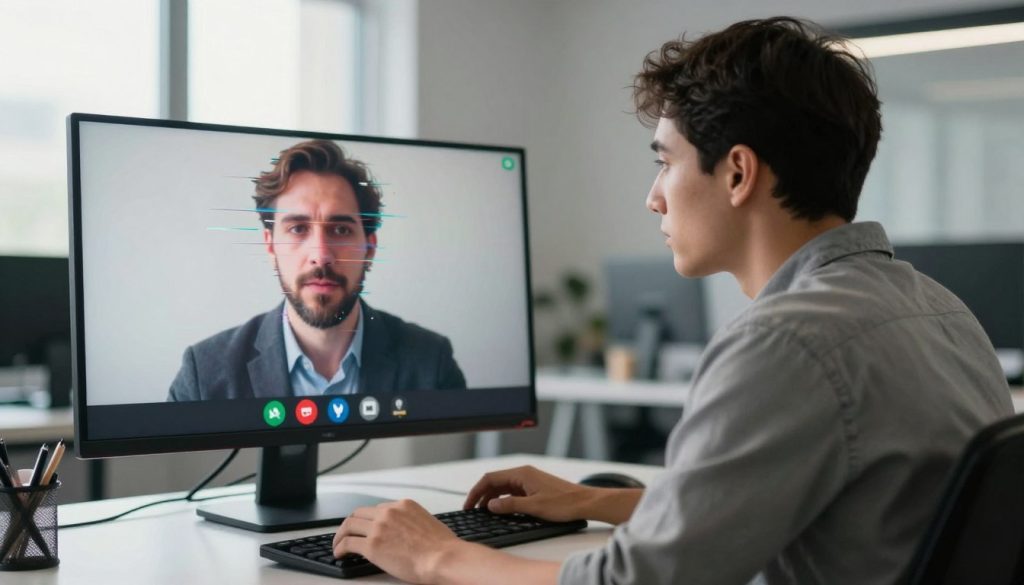
Audio syncing issues and strange lighting as red flags
Listen and watch together. Do the lip movements match the words perfectly? A tiny delay is a major warning sign.
Also, pay attention to the voice. Does it sound slightly robotic or too consistent? Trust your ears.
Lighting is another giveaway. Does the light on the person’s face match the room behind them? If shadows are wrong or the lighting doesn’t change as they move, be suspicious.
Look at the background, too. Objects might seem to shift or warp slightly between frames.
During intimate conversations, people often overlook these details. Scammers count on that emotional distraction.
If something feels uncanny or too perfect, pause. That’s your own intelligence telling you to verify further.
Verification 2.0: Safeguarding Against Deepfakes & AI Girlfriends
Modern trust must be built on actions that even sophisticated software can’t mimic. I call this Verification 2.0. It’s a practical set of new strategies for the current digital landscape.
Millions of people now engage with digital partners through various apps. This rise in synthetic companions means we need better checks.
Advanced physical movement checks and other human cues
The best test is a spontaneous, complex physical request. Current models struggle with rapid, unprompted actions.
Ask the person to touch their left ear with their right hand. Request a quick turn to the side. Have them block their face with a hand, then remove it.
These movements disrupt real-time rendering. Software often fails when an object passes in front of the face.

Vary your requests across different conversations. This rules out pre-recorded content or adaptive systems.
Meeting in public places: A modern approach to identity verification
If a connection grows, insist on a public meeting within the first month. Legitimate users will understand your caution.
Scammers using fabricated personas will resist. They give elaborate excuses. This resistance is a major red flag.
For women meeting men online, this step is crucial. Your safety must come before digital intimacy.
| Strategy | How to Execute | Why It Works | Best For |
|---|---|---|---|
| Complex Movement Test | Ask for an unprompted, specific action during a video call. | Current technology cannot render these convincingly in real time. | Initial video verification. |
| Public Meet-Up | Plan a coffee meet in a safe, public space within 30 days. | It provides undeniable physical proof of identity. | Developing online relationships. |
| Varied Verification | Use different tests across multiple chats and calls. | Prevents systems from learning and adapting to your checks. | Ongoing conversations. |
Conclusion
The era of relying on a simple video call for proof is conclusively over. Our digital world demands smarter, more active safeguards.
Trust must now be built through verifiable actions, not just pixels on a screen. I urge every user to adopt the Verification 2.0 strategies we discussed.
This technological shift is happening rapidly. It often outpaces the rules designed to protect people. This situation can put many, especially women, at greater risk.
Your awareness is the strongest defense. Share this knowledge. If a conversation or interaction feels unnatural, trust that instinct.
By staying informed and vigilant, we can all navigate this new landscape safely. Meaningful connections with real individuals are still not only possible but worth protecting.