
California leads the U.S. in producing solar energy, accounting for 29% of the nation’s overall solar supply. Different areas of the state receive plenty of sunlight every day. San Bernardino County, for instance, gets 5.9 peak sun hours daily. Riverside and San Diego counties follow closely with 5.8 and 5.7 hours respectively.
Because of this, Californians are going for residential solar energy. The average cost of solar panels is $2.51 per watt, so a typical 5 kilowatt (kW) system costs $12,550.
Going solar gives Californians a big saving potential. For instance, a 5 kW-solar power system can save them over $1,400 yearly on power bills. This adds up to $35,000 in savings over 25 years.
Solar panels help the environment too. A typical system can cut 3-4 tons of carbon emissions yearly. That’s like saving over 100 trees annually!
California offers great solar incentives too. There’s a 30% federal tax credit for installations and a property tax exclusion for systems installed before 2025.
At the same time, the Self-Generation Incentive Program (SGIP) rewards adding home batteries. When you install a 16-kWh battery system, you can get a $2,400 rebate. These perks make solar even more appealing.
Key Takeaways
- California is the top solar producer in the U.S., generating 29% of the nation’s total solar supply.
- Homeowners can save over $35,000 on electric bills over 25 years with a 5 kW solar system.
- Solar panel installations help reduce carbon emissions and save trees.
- California offers various incentives for solar adoption, including tax credits, property tax exclusions, and rebates.
- The average cost of solar panels in California is $2.51 per watt, with a 5 kW system costing $12,550.
The Benefits of Going Solar in California
When you go for solar energy in California, you get many perks as a homeowner. It lessens environmental impact, lowers energy bills, and boosts your property value. So, you’ll benefit a lot from taking advantage of California’s abundant sunshine
Reduce Your Carbon Footprint
Solar panels on your California home can reduce your carbon footprint a lot. A typical system can get rid of three to four tons of carbon emissions yearly. This is like planting 100 trees each year.
California gets about 278 days of sunshine annually. Solar panels can capture this resource and convert it into clean energy.
Lower Your Energy Bills
California is the 7th most expensive state for electricity costs. Prices have doubled over the last decade. Going solar can drastically lower, if not totally eliminate your monthly electricity bills.
The average electricity rate in California is 29.58 cents per kilowatt-hour. This is much higher than the national average of 16.79 cents. Californians use an average of 572 kWh per month. When you go solar, you free yourself from this high electricity cost.
SDG&E, SCE, PG&E, and LADWP have had an average annual rate increase of approximately 5%.
Increase Your Home's Value
Solar panels make your home’s value higher. In California, homes with solar systems sell at a 3.74% premium. This translates to a big financial benefit when you sell your house. Let’s say your home’s current value is $500,000. Installing solar panels could increase its value by $500,000 * 3.74% = $18,700.
California offers several solar panel financing options too. These include solar loans and the Property Assessed Clean Energy (PACE) program. These options make going solar more affordable for homeowners.
The Federal Income Tax Credit for solar installations provides additional incentives. It was 26% in 2020 and decreased to 22% in 2021.
| Benefit | Description |
|---|---|
| Reduced Carbon Footprint | Eliminate 3-4 tons of carbon emissions annually |
| Lower Energy Bills | Save up to 20% on monthly electricity costs |
| Increased Home Value | Solar homes sell at a 3.74% premium |
| Financing Options | Solar loans, PACE program, and tax credits available |
With all these benefits, now is the perfect time to embrace clean, renewable energy in the Golden State!
California Solar Incentives and Rebates
California offers a lot of incentives to encourage homeowners to adopt solar energy. These programs have made solar more affordable for Golden State residents.

Federal Solar Tax Credit
The Federal Solar Tax Credit is also known as the Investment Tax Credit (ITC). It allows homeowners to claim 30% of their solar installation costs as a tax credit. For example, if your solar installation costs you $20,000, you could potentially claim a tax credit of $20,000 * 30% = $6,000. This means that $6,000 would be directly subtracted from the amount of federal income tax you owe.
This one-time, nonrefundable credit applies to federal income taxes. It greatly reduces the initial cost of going solar for California homeowners.
Self-Generation Incentive Program (SGIP)
SGIP offers rebates for installing solar batteries with solar panels. These batteries store extra solar energy generated during the day.
Homeowners can use this stored power during peak evening hours or outages. So, you won’t have to rely too much on the grid, boosting your energy independence.
Property Tax Exclusion
California’s Property Tax Exclusion excludes the value of solar installations from property assessments. This ensures that installing solar panels won’t raise property taxes. The exclusion expires on January 1, 2025, so act soon.
Net Energy Metering (NEM) Program
The NEM program lets residents sell excess solar energy to utility companies. Recent changes (NEM 3.0) have reduced buyback rates by 75%.
But, solar customers still receive credit for power fed back to the grid. This program continues to offer financial benefits.
Although some past incentive programs in California, such as the California Solar Initiative (CSI), CSI-Thermal Program, Single-Family Affordable Solar Homes (SASH) Program, and Multi-Family Affordable Solar Housing (MASH) Program, have expired, the state remains committed to supporting the adoption of solar energy through various other initiatives and rebates.
| Incentive Program | Key Features |
|---|---|
| Federal Solar Tax Credit | 30% of installation costs, nonrefundable tax credit |
| Self-Generation Incentive Program (SGIP) | Rebates for installing solar batteries with solar panels |
| Property Tax Exclusion | Excludes solar panel value from property tax assessments until Jan 1, 2025 |
| Net Energy Metering (NEM) Program | Sells excess solar energy back to the grid for financial credit (reduced rates with NEM 3.0) |
California makes solar panels more affordable, saving homeowners money. As solar technology improves, going solar in California becomes even better.
California Home Solar Panels: Cost and Installation
Solar panel costs in California depend on system size, components, and installation expenses. As of September 2024, a 5-kilowatt system costs $12,359 before incentives. The average price is $2.47/W, with costs ranging from $10,505 to $14,213.
California’s average installation cost is $3.06 per watt before incentives. This matches closely with the national average of $3.01 per watt.
The solar panel system size greatly affects the overall cost. A 3-kW system costs $7,416, while a 10-kW system costs $24,719 before incentives. A 5.0-kW system usually offsets 100% of an average Californian home’s energy use.
This system costs about $12,700 before incentives and $8,890 after. Californians can choose from various solar panel financing options. These include outright purchases, loans, leases, and power purchase agreements.
Owning the system qualifies you for tax incentives like the federal investment tax credit (ITC). The ITC can reduce installation costs by 30%. Paying cash for a 5-kW system could save about $70,297 on electricity over 20 years.
By investing in solar panels in California, residents could potentially save up to $60,000 to $100,000 over a 25-year period, nearly 10 times the initial installation costs.
Solar panel costs vary by city and county in California. Fresno averages $3 per watt, Los Angeles $2.78, San Diego $2.87, San Francisco $3.07, and Sacramento $2.84.
Estimated solar panel costs in some California cities include:
- Los Angeles: $15,229
- San Diego: $15,014
- San Jose: $12,240
- San Francisco: $19,798
- Fresno: $10,435
- Sacramento: $12,240
Using EnergySage for multiple quotes can lead to competitive pricing. Doing this may reduce solar costs by up to 20%. Popular solar companies in California include Solar Optimum, Sunergy, and IntegrateSun.
Other companies are Demand Construction, NRG Clean Power, and G C Electric Solar. Evolution Energy, Solar 360 Building Services, ArtGreen Solar, and SolarLink Energy Construction are also well-known.
| System Size | Average Cost (Before Incentives) | Average Cost (After 30% Federal Tax Credit) |
|---|---|---|
| 3 kW | $7,416 | $5,191 |
| 5 kW | $12,359 | $8,651 |
| 10 kW | $24,719 | $17,303 |
Solar panels are a smart investment for most Californians, thanks to high electricity costs, incentives, and plentiful sunshine. You can typically recoup your investment in about 5.5 years and start saving money on your electricity bills shortly after.
Choosing the Right Solar Panel System for Your Home
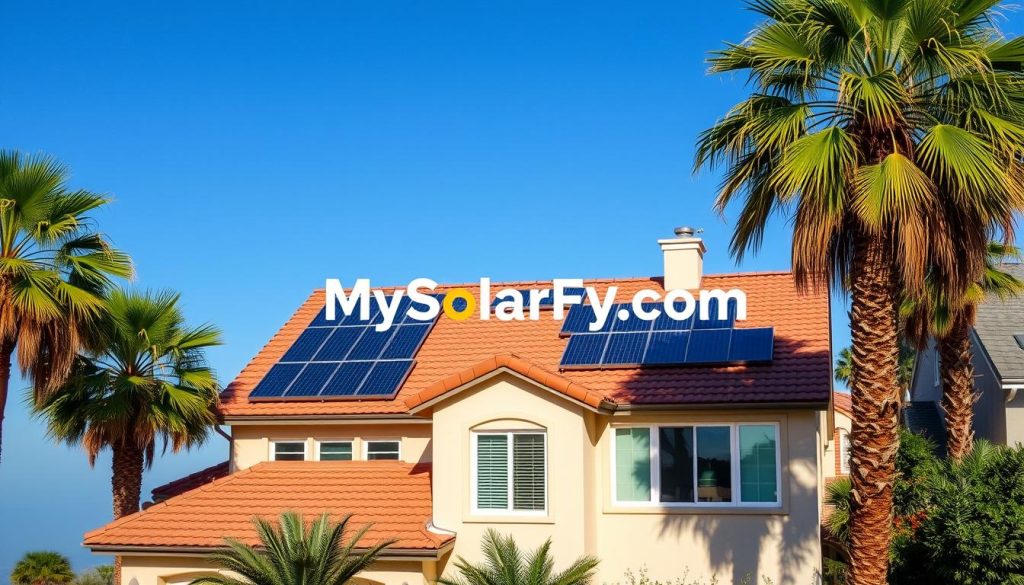
Picking the best solar panel system for your California home is important. Solar panels can meet 30-100% of your home’s power needs. To choose wisely, assess your home’s solar potential and figure out the ideal system size.
High-quality parts with good warranties are also necessary. A pro can help you select a system that maximizes savings and energy output.
Evaluating Your Home's Solar Potential
Start by checking if your home suits solar energy. The best roof angles for solar panels are between 30 to 45 degrees. South-facing roofs are ideal, but east and west-facing ones work too.
Look at your roof’s size, shape, and slope. Check for shade from trees or buildings nearby. Solar panels need at least four hours of direct sun daily.
Determining the Optimal System Size
Next, figure out the right system size for your home’s energy needs. The average solar system is 7.15 kilowatts, with a range of 3-11 kilowatts.
A typical 6 kW system in California costs $15,000 to $21,000 before incentives. Ask a pro to review your energy bills and suggest the best size.
Selecting High-Quality Solar Panels and Components
Choose top-notch solar panels and parts for long-lasting performance. California solar panels usually have 25-year warranties. Look for panels with high efficiency, low degradation, and strong warranties.
Think about adding storage batteries to your system. They’re worth it, especially after NEM 3.0 started in April 2023. The SGIP offers rebates for some energy storage systems.
| System Size (kW) | Average Cost (before incentives) | Average Cost (after incentives) | Estimated Monthly Savings |
|---|---|---|---|
| 4 kW | $10,000 – $14,000 | $5,000 – $8,400 | $50 – $100 |
| 6 kW | $15,000 – $21,000 | $7,500 – $12,600 | $80 – $150 |
| 8 kW | $20,000 – $28,000 | $10,000 – $16,800 | $100 – $200 |
Careful planning ensures your California solar panel system delivers maximum benefits. The right system can slash utility bills and boost property value. You’ll also help reduce your carbon footprint.
Navigating California Solar Regulations and Requirements
California’s solar regulations are necessary for homeowners thinking about panel installation. The California Solar Mandate took effect on January 1, 2020. It requires new residential buildings to install solar photovoltaic systems.
This mandate is part of Title 24 in the California Code of Regulations. It also requires “cool roof” certified materials in certain regions.
Homeowners should check their neighborhood’s guidelines before installation. They may need approval from their Homeowners Association (HOA). But, California law prevents HOAs from banning solar panels outright.
Working with a licensed solar installer is essential. They must hold a C-46 solar contractor license. These professionals understand California’s solar installation regulations.
Solar installers in California must secure permits from local authorities before proceeding with installations.
Factors like home efficiency and roof space affect the required system size. The system size is calculated using this equation: kWpv = (CFA x A)/1000 + (NDwell x B). After installation, inform your insurance provider to add the panels to your policy.
By following these regulations, homeowners can enjoy a reduced carbon footprint, lower energy bills, and increased home value with solar energy.
FAQ
How much of the U.S. solar supply does California generate?
What are the benefits of going solar in California?
What incentives and rebates are available for solar installation in California?
How much does a home solar panel system cost in California?
What should I consider when choosing a solar panel system for my home?
Are there any regulations or requirements for installing solar panels in California?
Source Links
- Solar Panel Cost in California – https://www.marketwatch.com/guides/solar/solar-panel-cost-california/
- Is Solar Worth It in California? (2024 Homeowner’s Guide) – https://www.ecowatch.com/solar/worth-it/ca
- What are the Benefits of Going Solar in California? – Forme Solar – https://formesolar.com/benefits-of-going-solar-in-california/
- California Solar Incentives, Tax Credits And Rebates Of 2024 – https://www.forbes.com/home-improvement/solar/california-solar-incentives/
- California Solar Initiative (CSI) – https://www.cpuc.ca.gov/industries-and-topics/electrical-energy/demand-side-management/california-solar-initiative
- California Solar Panel Cost: Is Solar Worth It In 2024? | EnergySage – https://www.energysage.com/local-data/solar-panel-cost/ca/
- Solar Panel Costs California: Are Solar Panels Worth It? – https://www.forbes.com/home-improvement/solar/solar-panel-costs-california/
- Pros and Cons of Solar Panels in California Home: Is It Worth It To Get Solar Panels in California for Homeowners? – https://www.linkedin.com/pulse/install-solar-panels-your-california-home-costs-benefits-crosby-tsfze
- Is a Home Solar Panel System a Good Investment in California? – ENACT – https://enact.solar/is-a-home-solar-panel-system-a-good-investment-in-california/
- Homeowner’s Guide to Going Solar – https://www.energy.gov/eere/solar/homeowners-guide-going-solar
- What Homeowners Need to Know About the California Solar Mandate – https://www.decra.com/blog/how-the-california-solar-mandate-affects-your-roof-what-homeowners-need-to-know
- Title 24: Your Guide to Solar Compliance in California – https://www.nabuenergy.com/blog/title-24-your-guide-to-solar-compliance-in-california/