
Navigating the complexities of marital property laws can be challenging, especially when considering the implications of a cooling-off period in divorce proceedings.
Recently, new property laws have been introduced in China, affecting foreign spouses and property ownership.
These changes have significant implications for expats living in China, particularly those considering divorce or prenuptial agreements.
Understanding these laws is crucial for making informed decisions about your future.
Key Takeaways
- The new laws introduce a 30-day divorce cooling-off period for foreigners.
- Expats should be aware of the implications for property ownership.
- A prenuptial agreement template can help protect your assets.
- Understanding the cooling-off period is crucial for navigating divorce proceedings.
- The new property laws affect foreign spouses and marital assets.
1. Recent Changes to Chinese Marriage and Property Legislation
Recent years have seen a major overhaul of China’s marriage and property laws, courtesy of the 2021 Civil Code Reforms. These changes have significant implications for both Chinese citizens and foreign spouses married to Chinese nationals.
Overview of the 2021 Civil Code Reforms
The 2021 Civil Code Reforms represent a comprehensive update to China’s legal framework regarding marriage and property. Key amendments include the introduction of a cooling-off period for divorces and changes to property division rules. These reforms aim to provide greater clarity and protection for individuals involved in marital disputes.

Why These Changes Matter for Foreign Spouses
For foreign spouses married to Chinese citizens, understanding these changes is crucial. The new legislation affects how marital property is divided during divorce proceedings and introduces a 30-day cooling-off period for divorces. Foreign nationals must be aware of their rights and obligations under the new law to navigate potential legal challenges effectively.
The 2021 Civil Code Reforms also highlight the importance of prenuptial agreements for international couples. By understanding the implications of these changes, foreign spouses can better protect their assets and interests in the event of a divorce.
2. What is the 30-Day Divorce Cooling-Off Period in China?
When divorcing in China, couples must navigate a 30-day cooling-off period, a legal requirement that applies to both Chinese citizens and foreign spouses. This provision is part of China’s divorce law reforms aimed at reducing impulsive divorces.
How the Cooling-Off Period Works
The cooling-off period begins once both parties agree to divorce and submit their application to the marriage registration authority. During this 30-day period, either party can withdraw their consent to the divorce, effectively canceling the divorce process. “The introduction of this cooling-off period reflects a significant shift in China’s approach to divorce, prioritizing reflection over haste.”

Timeline and Process Requirements
The process is as follows:
- The couple submits a divorce application.
- A 30-day cooling-off period begins.
- Either party can withdraw their consent during this period.
- If both parties still agree to divorce after 30 days, the divorce is registered.
“This mandatory waiting period is designed to give couples time to reconsider their decision, potentially reducing the divorce rate.” However, it also means that the divorce process cannot be rushed, affecting both Chinese nationals and foreign spouses residing in China.
Understanding the 30-day divorce cooling-off period is crucial for international couples, as it impacts their divorce proceedings in China. Foreign spouses should be aware that this law applies to them as well, influencing the timeline and process of their divorce.
3. Does the 30 Day Divorce Cooling-Off Period Apply to China Foreigners?
Foreign nationals married to Chinese citizens often wonder if they’re subject to the 30-day divorce cooling-off period. This question is crucial for international couples considering divorce in China.
Application to Foreign Nationals Married to Chinese Citizens
The 30-day cooling-off period is a mandatory waiting period for divorces in China. According to the 2021 Civil Code, this law applies to all couples registered in mainland China, regardless of their nationality. Therefore, if a foreign national is married to a Chinese citizen and they are registered in China, they are generally subject to this cooling-off period.
As stated by a legal expert, “The new divorce law in China has introduced a cooling-off period to reduce impulsive divorces.”
“The cooling-off period is a necessary measure to ensure that both parties have considered the consequences of their decision.”
Exceptions and Special Circumstances
There are some exceptions and special circumstances to consider:
- Divorces processed outside mainland China may not be subject to the cooling-off period.
- Couples with different nationalities may face additional complexities.
- Special circumstances, such as domestic violence, may expedite the divorce process.
| Scenario | Cooling-Off Period Applies | Exceptions |
|---|---|---|
| Foreign national married to Chinese citizen, registered in China | Yes | |
| Divorce processed outside mainland China | No | Depends on local laws |
| Domestic violence cases | May be exempt |
It’s essential for foreign nationals to consult with legal professionals to understand their specific situation and any potential exceptions.

4. Understanding China Marital Property Laws
Understanding the intricacies of China’s marital property laws is crucial for international couples. China’s marital property laws govern how assets are acquired, managed, and divided during marriage and in the event of divorce.
Community Property vs. Separate Property in China
In China, marital property is generally classified into community property and separate property. Community property includes assets acquired during the marriage, such as income, real estate, and investments. Separate property, on the other hand, refers to assets owned before the marriage or acquired during the marriage through gift or inheritance.

Default Property Division Rules
China’s default property division rules dictate that community property is to be divided equally between spouses in the event of a divorce. However, separate property remains with the original owner. Key aspects of these rules include:
- Equal division of community property
- Protection of separate property
- Consideration of debts and liabilities
How Chinese Law Differs from American Marital Property Laws
Chinese marital property laws differ significantly from American laws, particularly in the treatment of community property. While China follows a community property regime, some U.S. states adopt a community property system, whereas others follow equitable distribution principles. Understanding these differences is vital for international couples to navigate cross-border marriages and divorces.
The comparison between Chinese and American marital property laws highlights the importance of legal awareness for international couples. By understanding these laws, couples can better protect their assets and navigate the complexities of divorce.
5. Property Acquired Before and During Marriage
Understanding how property is classified and treated during marriage is crucial for couples, especially those with international backgrounds. Chinese law differentiates between property acquired before marriage and that obtained during the marriage.
Pre-Marital Property Protection
Property acquired before marriage is generally considered the personal property of the individual who acquired it. This means that if you owned a house or had savings before getting married, these assets are typically protected as your separate property.
Marital Property Classification
Assets acquired during the marriage, such as income earned by either spouse, are usually classified as communal property, belonging to both spouses equally. This includes real estate purchased during the marriage, unless specified otherwise.
Gift and Inheritance Considerations
Gifts and inheritances received by one spouse during the marriage are considered their personal property, not communal. However, it’s crucial to maintain clear records and documentation to prove the origin of such assets.

It’s also worth noting that couples can agree on the classification of property through prenuptial agreements, providing flexibility in managing their assets according to their preferences.
6. Buying Property in China as a Foreign Spouse
Buying property in China as a foreigner married to a Chinese citizen requires a thorough understanding of the country’s property laws. The process involves several legal and regulatory steps that must be carefully navigated.
Legal Requirements for Foreign Property Ownership
Foreigners, including foreign spouses of Chinese citizens, are subject to specific regulations when buying property in China. The key legal requirement is that the property purchase must be for personal use, not for resale or investment.
Registration and Documentation Needed
To buy property, foreign spouses need to provide necessary documentation, including a valid passport, marriage certificate, and proof of income or financial capability. The registration process involves submitting these documents to the relevant authorities.
| Document | Description |
|---|---|
| Passport | Valid passport of the foreign spouse |
| Marriage Certificate | Certificate proving the marriage to a Chinese citizen |
| Proof of Income | Documentation showing financial capability |
Joint Ownership vs. Single Ownership Considerations
Foreign spouses can consider either joint ownership with their Chinese spouse or single ownership. Joint ownership may simplify certain legal processes, but it also means shared liability.
Residency Requirements
In some cities, having a local residence permit can facilitate the property buying process. However, residency requirements vary across different cities in China.
Property Restrictions in Different Cities
Different cities in China have varying restrictions on property purchases by foreigners. For instance, some cities may limit the number of properties a foreigner can buy.

7. China Prenuptial Agreement Template for Expats
For expatriates living in China, understanding the nuances of prenuptial agreements is crucial for protecting personal assets. A prenuptial agreement, or prenup, is a legal contract between two individuals planning to get married, outlining the division of assets in the event of a divorce.
Legal Validity of Prenuptial Agreements in China
Prenuptial agreements are recognized in China under the Civil Code, which came into effect in 2021. However, the legal validity of a prenup depends on several factors, including:
- Compliance with Chinese law
- Notarization and registration
- Fairness and reasonableness
Essential Elements to Include in Your Prenup
A comprehensive prenuptial agreement should cover:
- Property division
- Debt responsibilities
- Spousal support
- Other financial matters
It’s essential to work with a legal professional to ensure that your prenup is valid and enforceable.
Notarization and Translation Requirements
For a prenup to be valid in China, it typically needs to be notarized. If the agreement is not in Chinese, a certified translation may also be required.
Working with Bilingual Legal Professionals
Given the complexities of Chinese law and the potential language barrier, it’s highly recommended to work with bilingual legal professionals who can guide you through the process, ensuring that your prenup meets all legal requirements.

By understanding the requirements and benefits of a prenuptial agreement, expats in China can better protect their financial interests and enjoy peace of mind.
8. Debt Liability in Chinese Marriage Law
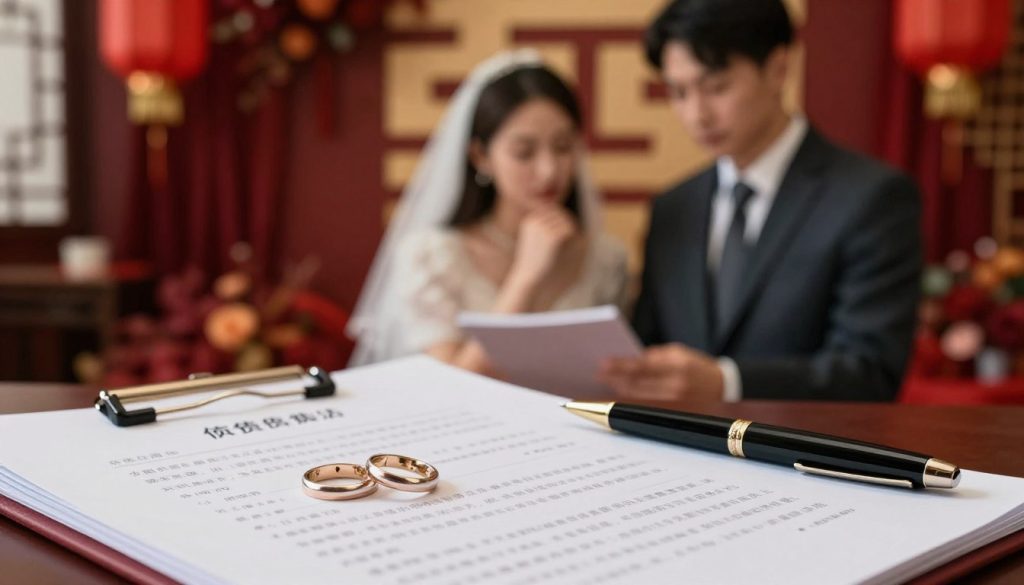
When it comes to debt liability, Chinese marriage law makes a distinction that is important for all couples to understand. Debt liability refers to the responsibility for debts incurred by spouses during marriage. Chinese law differentiates between joint debt and individual debt, affecting how debts are managed and divided.
Joint Debt vs. Individual Debt Under Chinese Law
Chinese law considers debts incurred for family purposes or with the consent of both spouses as joint debts. Joint debts are shared equally between spouses, regardless of who incurred the debt. In contrast, individual debts are the sole responsibility of the spouse who incurred them.
Protection from Spouse's Pre-Marital Debt
Generally, Chinese law protects spouses from debts incurred by their partner before marriage. Pre-marital debts remain the individual responsibility of the spouse who incurred them. However, if the debt is used for a joint purpose or both spouses benefit from it, it may be considered a joint debt.
Business Debts and Personal Liability
For business debts, the law distinguishes between debts incurred for family businesses and those for personal business ventures. Business debts that benefit the family are considered joint debts, while personal business debts are typically the individual’s responsibility.
The 2018 Supreme Court Interpretation on Marital Debt
The 2018 Supreme Court interpretation clarified that debts incurred during marriage are presumed to be joint debts unless proven otherwise. This interpretation placed the burden of proof on the spouse claiming the debt was individual.
9. Property Division During Divorce for International Couples
When international couples divorce, the division of property can become a legal minefield. The complexity arises from differing legal systems, jurisdictional issues, and the nature of the assets involved.

How Courts Handle Cross-Border Assets
Courts typically follow the laws of the jurisdiction where the property is located or where the couple resides. For international couples, this can mean navigating multiple legal systems. Cross-border assets, such as foreign bank accounts, real estate in different countries, or investments, require special consideration.
For instance, if a couple owns property in both the United States and China, they must comply with the laws of both countries regarding property division. This can involve understanding community property laws, separate property laws, and how each country treats marital assets.
Protecting Your Rights as a Foreign Spouse
To protect your rights, it’s crucial to understand the laws applicable to your situation. Seeking legal counsel experienced in international divorce and property law is essential. They can help you navigate the complexities and ensure that your rights are protected.
Additionally, maintaining detailed records of your assets, including those acquired before and during the marriage, can be beneficial. Prenuptial agreements, if properly drafted and executed, can also provide clarity on how assets should be divided.
Tax Implications for Americans
Divorce can have significant tax implications, especially for Americans with assets in multiple countries. The division of property can trigger tax liabilities, such as capital gains tax. Understanding these implications is crucial for planning.
For example, transferring property between spouses as part of a divorce settlement is generally not taxable. However, subsequent sale of that property could trigger capital gains tax. It’s essential to consult with a tax professional to understand the potential tax consequences of your divorce settlement.
10. Practical Steps to Protect Your Assets and Navigate Cross-Border Marriage
Navigating a cross-border marriage can be complex, especially when it comes to protecting your assets. International couples must consider various legal implications to safeguard their financial well-being.
Documentation You Should Maintain
To protect your assets, it’s essential to maintain thorough documentation. This includes records of all financial transactions, property deeds, and any agreements made during the marriage. Keeping detailed records can help prevent disputes and ensure a smoother process in case of divorce.
Recognition of Chinese Marital Agreements in the United States
Understanding whether Chinese marital agreements are recognized in the U.S. is crucial. While laws vary by state, generally, a prenuptial agreement made in China can be enforceable in the U.S. if it meets certain criteria, such as being in writing and signed by both parties.
When to Consult Legal Professionals
Given the complexities of cross-border marriages, consulting legal professionals is often necessary. They can provide guidance on estate planning and help draft marital agreements that are valid in both countries.
Estate Planning for International Couples
Estate planning is a critical aspect of protecting your assets. International couples should consider drafting wills that comply with the laws of both countries to avoid conflicts.
Key Mistakes to Avoid
One common mistake is not understanding the legal differences between the two countries. Couples should be aware of these differences to make informed decisions about their assets.
11. Conclusion
Understanding China’s marital property laws and the newly implemented cooling-off period is crucial for international couples navigating marriage and divorce in the country. The 2021 Civil Code reforms have significantly impacted how marital assets are divided and how divorces are processed, particularly for foreign spouses married to Chinese citizens.
The introduction of a 30-day divorce cooling-off period adds a layer of complexity to the divorce process, requiring couples to carefully consider their decisions. Meanwhile, China’s marital property laws dictate how assets acquired during marriage are divided, with implications for both Chinese and foreign-owned property.
For international couples, being aware of these laws and taking proactive steps to protect their assets is essential. This includes understanding the implications of prenuptial agreements, documenting financial transactions, and seeking legal counsel when necessary. By staying informed, couples can better navigate the legal landscape in China and make informed decisions about their future.