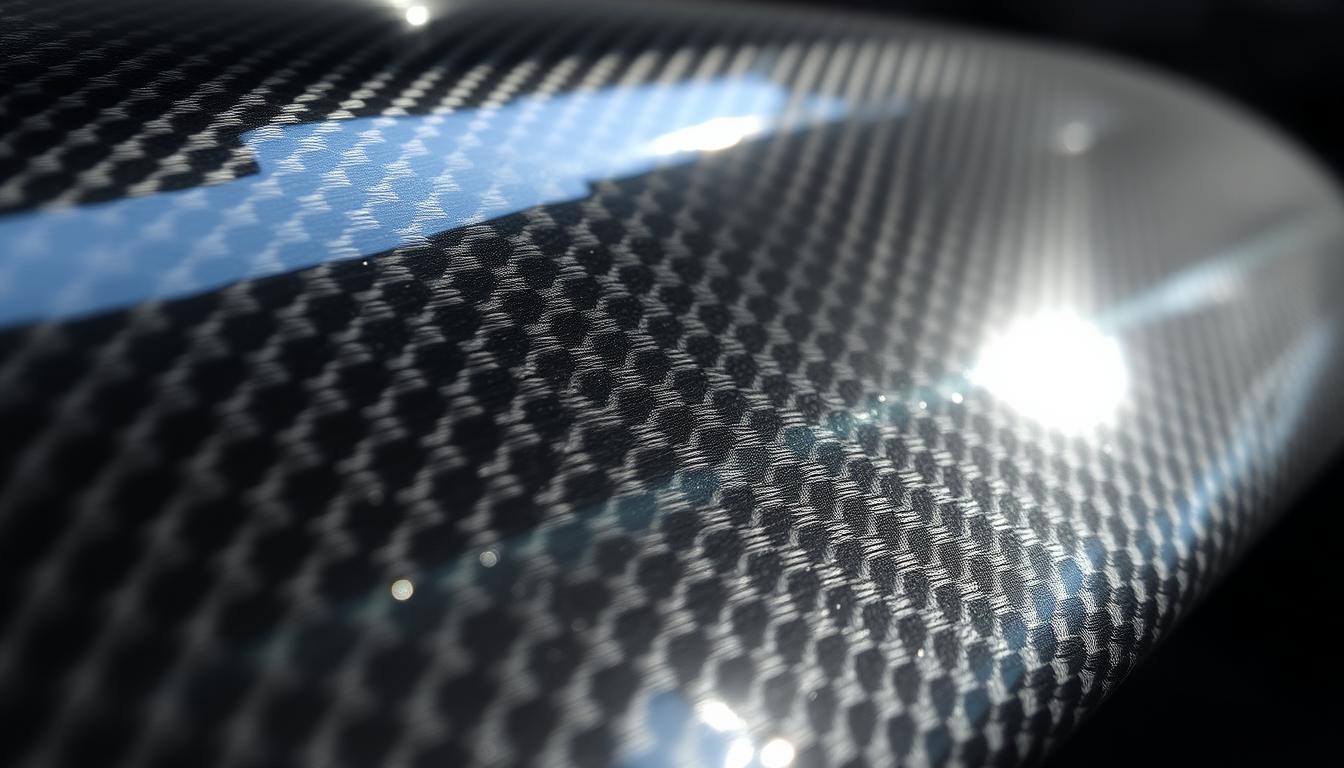
Imagine a material so advanced it can slash a car’s weight by 50% while boosting fuel efficiency by 35%—without compromising safety. That’s the power of modern engineering’s superstar: carbon fiber.
This composite combines unmatched stiffness and tensile strength with featherlight qualities, outperforming aluminum by 2.5x in rigidity. Originally developed in the 1800s, it’s now reshaping everything from jet engines to tennis rackets.
Why does this matter? In aerospace, every pound saved translates to fuel savings. For athletes, lighter gear means faster reactions. Even medical science benefits—its biocompatibility is revolutionizing prosthetics.
Durability is another win. Unlike metals, it resists rust and thrives in salty seas or scorching heat. While costs remain high, innovations in manufacturing are unlocking new possibilities.
Let’s explore how manufacturers create these fibers and why they’re ideal for aircraft wings, racing bikes, and medical devices. You’ll discover how production breakthroughs made mass adoption possible, real-world comparisons with conventional materials, and emerging uses in renewable energy systems.
Key Takeaways
- Offers a strength-to-weight ratio surpassing steel and aluminum
- Widely used in aerospace, automotive, and sports industries
- Reduces vehicle weight dramatically for better fuel efficiency
- Emerging applications in medical implants and prosthetics
- Resists corrosion, ideal for extreme environments
What is Carbon Fiber?
Carbon fiber is a material valued for its high strength and low weight. It consists of very thin fibers, usually 5 to 10 micrometers in diameter, composed primarily of carbon atoms.
Basic Properties and Structure
Composition: Primarily carbon atoms.
Structure: The carbon atoms are arranged in a specific, organized pattern.
Size: Each fiber is exceptionally thin.
Characteristics:
- High strength relative to its weight.
- Low density, meaning it is lightweight.
- Resistance to bending.
- Ability to be formed into various shapes.
Historical Development
The development of carbon fiber has progressed over time. Early applications involved carbonized materials in items like light bulbs. Modern production methods, particularly those utilizing polyacrylonitrile (PAN), began in the 1960s. Current manufacturing techniques involve controlled heating processes to transform precursor materials into the final carbon fiber product.
How is Carbon Fiber Manufactured?
The production of carbon fiber is a complex process that transforms precursor materials into high-strength fibers through a series of carefully controlled steps. The most common precursor is polyacrylonitrile (PAN), which accounts for a huge portion of carbon fiber production.
Main Manufacturing Stages
Spinning:
PAN is dissolved in a solvent to create a liquid solution. This solution is then forced through small holes (spinnerets) to form thin fibers. The fibers are solidified through chemical baths or air drying.
Stabilization (Oxidation):
The spun PAN fibers are heated in air at relatively low temperatures (around 200-300°C, roughly 400-570°F). This process stabilizes the fiber’s chemical structure by introducing oxygen, preventing melting during subsequent high-temperature processing.
Carbonization:
The stabilized fibers are heated to very high temperatures (usually 1000-3000°C, or 1800-5400°F) in an oxygen-free environment. This process drives off non-carbon atoms, leaving behind a fiber composed primarily of carbon atoms arranged in a graphitic structure. This is the stage that develops the final properties of the carbon fiber.
Surface Treatment and Sizing:
The carbonized fibers undergo surface treatment to improve bonding with resin matrices. A sizing agent (a coating) is applied to protect the fibers during handling and enhance their adhesion to resins.
Composite Formation:
The carbon fibers are combined with a resin matrix (e.g., epoxy) to form a composite material. Different methods are used to create composite parts:
- Prepreg Lamination: Carbon fibers are pre-impregnated with resin and layered into molds, often used in aerospace for precise alignment.
- Resin Transfer Molding (RTM): Dry carbon fibers are placed in a mold, and liquid resin is injected under pressure, suitable for complex automotive parts.
- Filament winding: fibers are wound around a mandrel to create a desired shape.
The careful control of temperature, atmosphere, and processing parameters throughout these stages is necessary for achieving the desired strength and performance characteristics of the final carbon fiber composite.
Types of Carbon Fiber
Not all high-performance materials are created equal—some bend while others snap under pressure. Their characteristics are influenced by manufacturing processes, precursor materials, and structural configurations, such as weave patterns and filament counts.
Weave Patterns and Structural Configuration:
Weave Patterns:
The way carbon fibers are woven impacts the resulting composite’s flexibility and stability a lot.
- Plain Weave: Offers maximum stability and is ideal for flat surfaces, such as aircraft floor panels.
- Twill Weave: Its diagonal crisscross pattern provides better conformability for curved surfaces, commonly used in aerospace components.
- Satin Weave: Offers the highest conformability for complex molds, suitable for intricate shapes like helicopter blades.
Filament Count:
Carbon fiber tows are categorized by the number of individual filaments they contain. Here are some examples:
- 3K (3,000 filaments) for bicycle frames
- 12K for automotive body panels
- 48K for industrial machinery reinforcement
Higher filament counts increase cost-efficiency but may reduce precision in complex curves.
Material Properties and Precursors:
Modulus Ratings: Indicate the stiffness of the carbon fiber.
- Ultra-High Modulus (UHM) fibers, with high GPA ratings, are used in demanding applications like satellite components.
- Intermediate Modulus (IM) fibers provide a balance of flexibility and rigidity, suitable for applications like racing helmets.
Precursor Materials: The raw materials used to produce carbon fibers influence their final properties.
- PAN-based carbon fibers dominate the market, accounting for a big portion of composite production.
- Pitch-based carbon fibers excel in thermal management applications, such as brake systems.
Application-Specific Variations:
The choice of carbon fiber type is important for specific applications.
- Unidirectional tapes are used in wind turbine blades for maximum strength in a single direction.
- Custom weaves are developed for specialized applications like prosthetics.
The diversity of carbon fiber types has allowed for advanced applications, such as the increased usage of advanced materials in modern jet aircrafts.
In essence, selecting the appropriate carbon fiber variant, considering weave patterns, filament counts, modulus, and precursor materials, is necessary for achieving optimal performance in different engineering applications.
The Strength and Lightness Advantage
Engineers face a constant challenge: building structures that won’t buckle under pressure yet don’t weigh a ton. This balancing act finds its solution in advanced composites that rewrite the rules of material science.
Strength-to-Weight Ratio
Imagine lifting a steel beam with one hand. Now achieve the same support using material five times lighter. That’s the power behind this innovation’s 10:1 strength-to-weight advantage over steel. In aircraft design, this ratio means fuel savings of 20-35% per flight.
Superior Stiffness & Durability
While aluminum bends under stress, layered composites maintain shape like architectural steel beams. Proper orientation creates materials 18x stronger than steel in critical applications. BMW’s i3 electric car uses this principle for crash-resistant frames that outperform traditional metals.
Here’s a clearer comparison of carbon fiber with other metals:
| Property | Steel | Aluminum | Carbon Fiber |
|---|---|---|---|
| Tensile Strength (PSI) | 60,000 | 45,000 | 500,000 |
| Weight (lbs/cu ft) | 490 | 170 | 98 |
| Max Temp (°F) | 1,300 | 1,221 | 750 |
Enhanced Thermal Stability
Rocket nozzles demand materials that won’t warp under extreme heat. Carbon composites maintain strength at 750°F—perfect for reusable spacecraft heat shields. Their low thermal expansion also keeps precision instruments accurate in desert heat or arctic cold.
From race car brakes to wind turbine blades, these properties make high-strength products essential in modern engineering. The right material choice can really turn impossible designs into everyday solutions.
Beyond Basic Strength
Young’s modulus reveals hidden advantages. Standard versions offer 15 million PSI stiffness, while ultra-rigid types hit 45 million—ideal for satellite components needing zero flex. Thermal conductivity works differently: heat flows easily along the fiber used direction but stays contained sideways.
| Property | Steel | Aluminum | Advanced Carbon Composite |
|---|---|---|---|
| Tensile Strength | 60,000 PSI | 45,000 PSI | 500,000 PSI |
| Density | 7.7 g/cm³ | 2.7 g/cm³ | 1.6 g/cm³ |
| Stiffness | 29 Msi | 10 Msi | 45 Msi |
These extremely high values explain why 60% of new Boeing jets use this material in wings and fuselages. Unlike metals, it maintains strength in saltwater and acidic environments—an important factor for offshore wind turbines.
Engineers customize properties by adjusting fiber used orientations. Unidirectional layouts maximize strength in specific directions, while woven patterns distribute stress evenly. This versatility makes composites the Swiss Army knife of modern manufacturing.
Applications in Aerospace
Modern jets soar higher and faster thanks to advanced carbon composites transforming aircraft design. These materials now form the backbone of 60% of new commercial planes, cutting weight while boosting performance.
Boeing’s 787 Dreamliner demonstrates this shift. Its fuselage uses composite sheets that reduce airframe weight by 20% compared to aluminum designs. This weight saving translates to 25% better fuel efficiency on long-haul flights.
Rolls-Royce also deploys these materials in jet engine fan assemblies. The high modulus properties prevent blade deformation at 2,500 RPM speeds. Main applications include:
- Wing spars handling 150% more stress than steel equivalents
- Heat-resistant engine nozzles maintaining shape at 1,800°F
- Satellite frames surviving extreme temperature swings
The tensile strength proves vital during turbulence. Airbus A350 wings flex 40% more without cracking—a safety feature enabled by layered composites. As production costs drop, these materials will dominate next-gen aircraft designs.
Applications in Automotive
Automakers are racing to build cars that feel nimble yet protect like tanks. Advanced carbon composites deliver both—transforming vehicles into marvels of modern engineering without adding bulk.
Innovations in Car Design
BMW’s i3 electric hatchback proves lighter can be safer. Its passenger cell uses reinforced composites that absorb 40% more crash energy than steel while weighing 60% less. This structure innovation lets engineers redistribute weight for better handling.
Production breakthroughs make these materials viable for mainstream models. Resin Transfer Molding (RTM) creates complex parts like Lexus LFA body panels in half the time of traditional methods. Benefits include:
- Components annealed at 356°F for enhanced temperature resistance
- Seamless integration with aluminum chassis parts
- 20% faster assembly than metal fabrication
Performance gains are staggering. Replacing steel components cuts vehicle weight by up to 850 pounds—boosting fuel efficiency 35% in city driving. Porsche’s 911 GT3 RS uses this approach for its roof panel, achieving perfect 50/50 weight distribution.
While costs remain high, automakers like Tesla are investing in automated production lines to make carbon composites mainstream. The result? Cars that turn sharper, stop shorter, and protect better—all while sipping fuel.
Applications in Sports Equipment
Athletes chasing milliseconds and millimeters now wield gear engineered at the molecular level. Advanced carbon composites deliver unmatched responsiveness while shaving critical weight—transforming how records get broken.
Powering Peak Performance
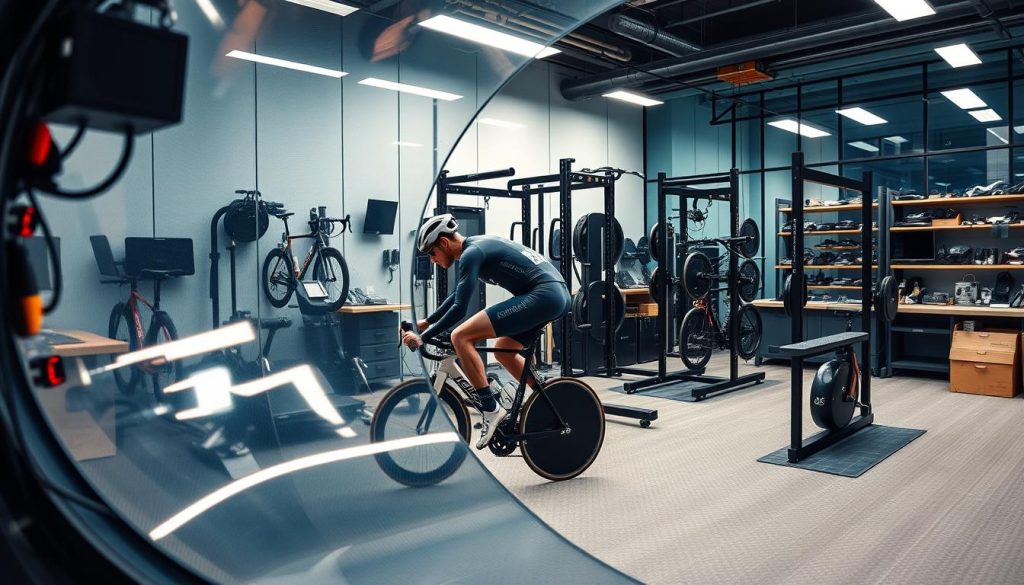
Superior stiffness turns energy transfer into a science. When a tennis player swings a racket, 98% of their force reaches the ball—compared to 82% with aluminum frames. This precision comes from PAN-based materials that flex predictably under stress.
Bicycle designers exploit this trait for Tour de France victories. Frames weighing under 15 pounds maintain rigidity across mountain descents, letting riders conserve 12% more energy per hour. Golf clubs showcase similar advantages—40% lighter heads create faster swings without sacrificing control.
Here’s a quick comparison:
| Equipment | Traditional Material | Carbon Composite Upgrade |
|---|---|---|
| Road Bike | Steel (22 lbs) | 15 lbs (-32%) |
| Tennis Racket | Aluminum | 30% larger sweet spot |
| Running Shoe | EVA Foam | +0.5 km/h speed |
Wilson’s Pro Staff RF97 tennis racket demonstrates smart design integration. Its layered structure directs vibrations away from players’ arms, reducing fatigue during five-set matches. Also, Specialized’s S-Works bikes use directional fiber alignment to balance lateral stiffness with vertical compliance.
These innovations prove that material science isn’t just about strength—it’s about creating tools that become natural extensions of athletic ambition.
Other Noteworthy Applications
Beyond its well-known applications in aerospace and automotive, carbon fiber’s versatility is driving innovation across diverse industries. Its ability to combine strength, lightness, and tailored properties makes it ideal for infrastructure, renewable energy, consumer goods, and even artistic expression.
Renewable Energy:
Wind turbine blades, often exceeding 260 feet in length, utilize carbon fiber composites to achieve huge weight reductions compared to traditional fiberglass. This allows for increased energy generation at lower wind speeds and extends the lifespan of the turbines. PAN-based precursors are a common component for this.
Infrastructure and Construction:
Carbon fiber reinforced polymer (CFRP) sheets are used to strengthen and rehabilitate bridges, buildings, and other infrastructure, offering faster installation and increased durability.
Electronics:
Ultra-thin carbon fibers are employed in electronic devices, like mobile phones, computers, and televisions, for their superior heat dissipation properties, enhancing performance and longevity.
Luxury Goods and Consumer Products:
High-end watches and other luxury items utilize intricately woven carbon fiber patterns for their aesthetic appeal and durability. Specialized precursor treatments allow for the creation of exceptionally thin and precise weaves.
Medical Technology:
Carbon fiber composites are used in the development of advanced prosthetic limbs, designed to mimic the density and functionality of natural bone.
Art and Architecture:
Artists and architects are exploring the sculptural and structural potential of carbon fiber, creating innovative installations and designs. Resin infused sheets, and pitch derived cores are used in these applications.
Specialized Applications:
Rayon-derived carbon fibers are used in fireproof applications, such as theater curtains. Petroleum pitch-based carbon fibers are used in extreme environments, such as components for Mars rovers.
The adaptability of carbon fiber stems from the ability to tailor its properties through variations in precursor materials and manufacturing processes. While PAN-based methods dominate production, niche applications benefit from the unique characteristics of rayon and pitch-based fibers.
The Power of Carbon Fiber
Carbon fiber is a material that’s both incredibly strong and surprisingly light.It’s changing how we build things, from airplanes and cars to sports gear and medical tools. The way it’s made, the patterns it’s woven into, and the materials it starts from, all let us fine-tune it for different jobs.
Even though it can be expensive, new ways of making it are constantly being developed. This material lets us build things that are lighter, stronger, and last longer. As we learn more, carbon fiber will keep playing a big role in creating new and better technology. It’s not just a material; it’s a key to making things better.

